
Less pressure, more direction
We live in a time where almost everything seems important.
An email comes in.
A message demands attention.
An idea pops into your head.
There is still administration to finish.
You want to exercise.
You need to complete something.
And somewhere in between, you are also trying to think about where you are actually going.
The problem is usually not that we do too little.
The problem is that we do not distinguish enough between what is urgent and what is truly important.
That is where the Eisenhower Matrix comes in.
A surprisingly simple model that helps you work not harder, but with better priorities.
From president to productivity
The Eisenhower Matrix is named after Dwight D. Eisenhower, former President of the United States and Supreme Commander of the Allied forces during the Second World War.
He was known for his ability to set priorities under enormous pressure.
The idea behind the matrix is simple:
Not everything that feels urgent is important.
And not everything that is important feels urgent.
That sounds logical.
But in everyday life, this is exactly where we often go wrong.
We respond to whatever shouts the loudest.
Not to what creates the most value.
Four quadrants
The matrix divides tasks into four categories.
1. Important and urgent
These are the fires.
A deadline that expires today.
A technical failure.
An urgent client issue.
A bill that needs to be paid immediately.
These tasks need to be done.
There is usually little debate.
The problem begins when almost your entire life takes place inside this quadrant.
Then you are constantly reacting.
You are busy, but rarely in control.
2. Important, but not urgent
This may be the most interesting quadrant of all.
This is where the things live that improve your life in the long run.
Strategy.
Health.
Learning.
Relationships.
Planning.
Creative work.
Building a business.
Developing a new skill.
These tasks do not shout.
Nobody calls you to say that you really need to work on your long-term vision today.
And that is exactly why they are so easily postponed.
But this is where growth happens.
This is the quadrant where your future is built.
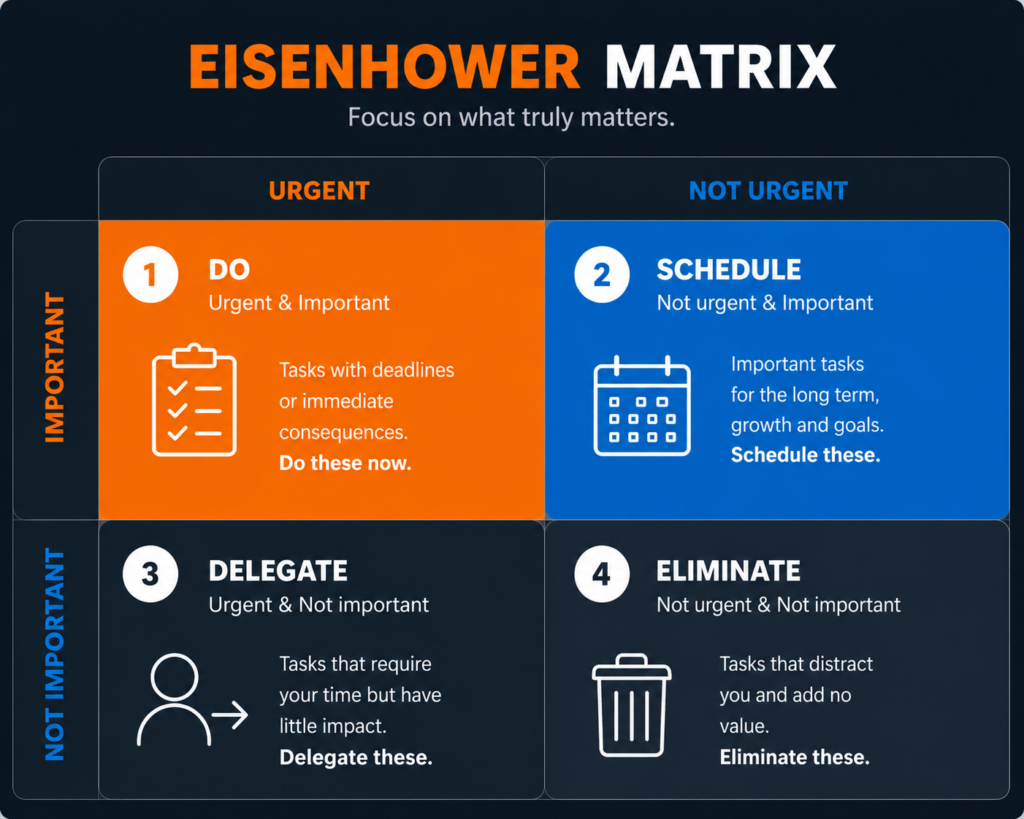
3. Urgent, but not important
This is the deceptive quadrant.
A notification.
Someone else’s request.
A phone call.
A meeting you do not really need to attend.
It feels like you need to act.
Now.
But the real question is:
Do you actually need to do this?
Some tasks can be delegated.
Others can be answered later.
And some can simply be ignored.
Urgency is often an emotional signal.
Importance is a strategic decision.
4. Not important and not urgent
This is where the time-wasters live.
Mindless scrolling.
Checking the news again and again.
Unnecessary perfectionism.
Doing tasks that add almost no value.
Of course, not every moment needs to be productive.
Rest matters.
But there is a difference between consciously relaxing and unconsciously losing time.
The first gives you energy.
The second often leaves you feeling empty.
The biggest misunderstanding about productivity
Many people think productivity means:
Doing more.
Checking off more tasks.
Working more hours.
Creating more output.
But real productivity is mostly about selection.
What do you not do?
What do you say no to?
What deserves your best hours?
Someone who finishes twenty small tasks may make less progress than someone who completes two important ones.
Busyness and progress are not the same thing.
That may be the most important lesson of the Eisenhower Matrix.
Quadrant two is where the difference is made
Interestingly, many people try to become more efficient mainly in quadrant one.
Respond faster.
Work harder.
Use another app.
Install another planning tool.
But anyone who wants a calmer and more intentional life should spend more time in quadrant two.
Thinking ahead prevents problems.
Good maintenance prevents breakdowns.
A financial plan prevents panic.
A good conversation prevents escalation.
Learning prevents stagnation.
Rest prevents exhaustion.
Many urgent problems are simply important tasks that were postponed for too long.
A practical example
Imagine you run your own business.
Your list for today looks like this:
An angry client calls.
Your website needs to be redesigned.
Your inbox contains 47 messages.
You want to develop a new service.
Your administration is behind.
WhatsApp messages keep coming in.
Without a system, everything feels urgent.
With the Eisenhower Matrix, things become clearer.
The angry client?
Important and urgent.
The overdue administration?
Probably the same.
The new service?
Important, but not urgent.
Most WhatsApp messages?
They feel urgent, but they are often not important.
Redesigning the website?
Probably quadrant two: important, but something you can schedule.
Suddenly, a chaotic list becomes manageable.
Not because there is less work.
But because you know where to start.
The matrix is really a way of thinking
The beauty of the Eisenhower Matrix is that you do not need complicated software.
A sheet of paper is enough.
Draw a cross.
Four quadrants.
Then place your tasks inside them.
But the real work happens before that.
For every task, you need to ask yourself:
Is this truly important?
That can be confronting.
Because much of what we do, we do out of habit.
Because others expect it.
Because it feels familiar.
Because reacting is often easier than creating.
The matrix makes that visible.
From reacting to directing
Perhaps that is what this model is really about.
Not tasks.
But control.
When you constantly live according to urgency, the outside world controls your agenda.
Notifications control your attention.
Requests control your time.
Problems control your day.
When you start thinking in terms of importance, something changes.
You increasingly decide where your attention goes.
And attention may be one of the most valuable resources we have.
You cannot buy back time.
You cannot buy back attention either.
One simple rule for every morning
You do not need to draw the full matrix every day.
You can also start with one simple question:
Which two or three things would make a real difference today?
Do those first.
Not your inbox.
Not your notifications.
Not the smallest task simply because it feels satisfying to tick it off.
But the thing that makes you think, at the end of the day:
Yes. This actually moved me forward.
That is productivity.
Not moving faster.
But choosing better.
Final thought
The Eisenhower Matrix almost seems too simple.
Four quadrants.
Four choices.
Do.
Schedule.
Delegate.
Delete.
But good ideas do not have to be complicated.
Sometimes one clear question is enough to change your day:
Is this urgent, or is this important?
And sometimes that same question ends up changing much more than your schedule.
Leave a Reply